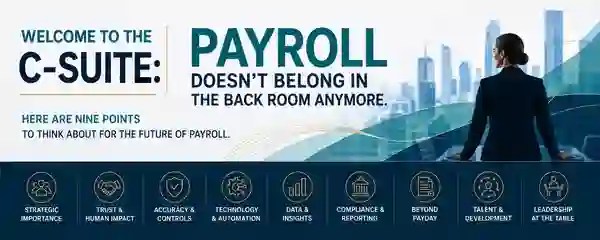
Here are nine points to think about for the future of payroll.
By M. Alison Rodgers
Payroll has traditionally been one of those functions people notice primarily when something goes wrong. A correct payroll disappears quietly into the rhythm of an organization. An incorrect one can consume the attention of employees, managers, Human Resources, Finance, and leadership very quickly.
Yet we continue to organize payroll as though it were primarily a transaction-processing function, even as the work itself has fundamentally changed.
Finance evolved from bookkeeping and accounting into financial strategy and gained permanent representation in the C-suite. Human Resources evolved from personnel administration into workforce strategy and gained the CHRO.
Payroll may be approaching a similar moment.
UKG and KPMG are already asking whether payroll belongs at the executive table. Their research describes payroll as a function at a tipping point: one that often represents 40% to 60% of operating expenses while remaining fragmented or under-resourced in many organizations. UKG has even discussed the possibility of a future executive responsible for total labor oversight, including payroll and workforce management. (UKG)
So perhaps the real question is becoming:
Is employee compensation finally next?
1. Payroll Has Become a Strategic Function
Payroll touches virtually every employee and governs what is typically one of an organization’s largest expenses: labor.
UKG and KPMG estimate that payroll inefficiencies and errors can cost organizations 2% to 4% of total labor spend. At enterprise scale, that is not administrative noise. It is a financial-control issue. (UKG)
Payroll also contains an extraordinary amount of workforce information. Overtime, compensation changes, geographic labor costs, deductions, tax exposure, employee movement, timekeeping, and other payroll data can provide insight into how an organization is actually operating.
That changes the role of payroll leadership. The function is no longer simply producing transactions. It is increasingly participating in financial control, compliance, workforce intelligence, technology, and employee trust.
Whether the eventual title is Chief Payroll Officer, Chief Labor Management Officer, or something we have not named yet is less important than the underlying question:
Who represents employee compensation at the executive table?
2. Payroll Is Where the Organization Intersects
The modern payroll department sits at the intersection of Human Resources, Finance, Benefits, Tax, Timekeeping, Operations, and technology.
Compensation changes may begin with management or HR. Benefits elections come through another process. Time is captured elsewhere. Retirement contributions involve plan administrators. Tax obligations change depending on where employees live and work. Accounting relies on payroll data for the general ledger, while Finance depends on it for labor-cost reporting and planning.
Payroll brings those separate streams together and turns them into something concrete: pay, deductions, taxes, contributions, reporting, and records.
That position gives payroll an unusually broad view of how the organization is functioning. A payroll error may actually begin with an incorrect effective date, a failed benefits feed, a missing approval, poor system configuration, or inaccurate information entered several steps earlier.
Strong payroll leadership therefore requires more than correcting the final transaction. It requires understanding where information came from, where the process failed, and which part of the organization has to participate in fixing it.
That is difficult to accomplish when payroll has responsibility for the outcome but little authority over the systems and decisions that create it.
3. Payroll Is a Trust Contract
Today’s payroll director should hold one truth as absolute: there is a human being on the other side of every payroll record.
Every pay cycle, that individual relies on the payroll department to perform with zero errors.
The employee may never know how many systems, approvals, tax rules, benefit elections, time records, deductions, or reconciliations were required to produce the final result. They should not have to. What matters to them is that the compensation they earned arrives accurately and on time.
That responsibility carries particular weight because many American households have limited room for financial disruption.
The Federal Reserve reported in 2026 that 55% of adults had emergency savings sufficient to cover three months of expenses. That means 45% did not. Even more striking, 18% said the largest emergency they could handle immediately using savings alone was less than $100. (Federal Reserve)
A materially incorrect or missed paycheck can therefore affect far more than an employee’s bank balance. Housing, transportation, childcare, utilities, food, medication, debt payments, and ordinary family obligations are often planned around the expectation that wages will arrive when promised.
Employees are the foundation of everything an organization does. Without them, the business does not function. Without appropriate payroll, employees cannot reliably manage the lives that make coming to work possible.
That is why I think of payroll as a trust contract.
Every payday, the organization is effectively saying:
We value the work you do. We recognize your participation in this organization. We will compensate you as we promised, because your contribution matters — and because you matter.
Payroll is where the organization keeps that promise.
The idea of payroll as part of the psychological contract between employer and employee is not unique to this argument. Payroll and HR educators have similarly described accurate pay as a tangible expression of organizational reliability and noted how quickly inaccurate or late pay can damage employee trust. (HR Certification)
4. Humane Payroll Has Roots
The idea that employees should be understood as human beings rather than simply units of production is not new.
Elton Mayo’s Human Relations Theory helped move management thinking toward the importance of communication, workplace relationships, recognition, and the employee’s social experience at work. The Hawthorne research itself has been criticized and should not be overstated, but Mayo’s work remains an important part of the historical movement toward treating employees as individuals rather than simply economic resources. (Two Teachers)
J. Stacy Adams’ Equity Theory added another dimension by examining how employees perceive the relationship between their contributions and what they receive in return.
Related organizational-justice theory distinguishes among distributive justice, procedural justice, and interactional justice: whether the outcome is fair, whether the process producing it is fair, and whether the person is treated fairly throughout that process. (Swiss University)
Payroll sits directly inside all three.
An employee needs a fair outcome: correct compensation, deductions, taxes, contributions, and records.
The process producing that outcome must be accurate, consistent, controlled, and competent.
And when something does go wrong, the person affected deserves urgency, honest communication, a clear path to resolution, and respectful treatment.
Applied specifically to payroll, those ideas form the basis of what I think of as Humane Payroll Theory.
5. Humane Payroll Requires Operational Discipline
Humane does not mean soft.
A humane payroll operation should be an exceptionally disciplined payroll operation precisely because the consequences of failure belong to someone else.
Accurate data matters. Good controls matter. Appropriate staffing matters. Training and competency matter. Reliable systems matter. Clear escalation paths matter. Human accountability matters.
Together, they create the operational architecture that allows an organization to keep its compensation promise.
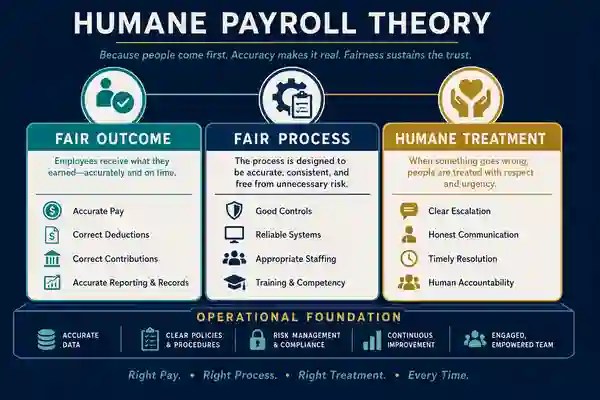
Fair Outcome
Accurate Pay • Correct Deductions • Correct Contributions • Accurate Reporting
Fair Process
Good Controls • Reliable Systems • Appropriate Staffing • Training + Competency
Humane Treatment
Clear Escalation • Honest Communication • Timely Resolution • Human Accountability
These are not simply employee-relations concepts. They are operating requirements.
And some of them require decisions that payroll cannot make by itself. Staffing levels, technology investment, system ownership, data access, cross-functional accountability, and organizational priorities are executive decisions.
If payroll is accountable for the result, its leadership needs enough organizational influence to help shape the environment producing that result.
6. The Future Payroll Leader Will See Problems Before They Become Pay Problems
Payroll accuracy begins long before a payroll run is released.
The future payroll leader will need to understand where information originates, how it moves through the organization, where it can fail, and how to enable a team to recognize an exception before it becomes an employee’s problem.
That begins with source data.
Time may originate from a swipe clock, badge reader, mobile application, manually entered timecard, supervisor-approved schedule, piece-rate record, or another workforce-management system.
In large manufacturing, healthcare, distribution, and other shift-based environments, those records can become considerably more complicated. Payroll may need to account for overtime, shift differentials, required breaks, union provisions, premiums, call-back time, and other rules that affect compensation.
Those records can also matter beyond payroll. Accurate clock-in and clock-out information may become relevant when establishing whether an employee was working at the time of a workplace incident or when reconstructing events for an audit, investigation, or workers’ compensation matter.
The regulatory environment adds another layer. Federal, state, and local tax tables change. Employees cross jurisdictions. Reporting requirements evolve. New laws and regulations alter withholding, taxation, and employer obligations.
The future payroll executive will need a team capable of absorbing those changes quickly and understanding how they affect configuration, processes, controls, and the next payroll before an error occurs.
That responsibility continues after money is transmitted.
For payroll departments operating their own tax accounts — and for payroll providers working on behalf of clients — appropriate administrative access to EFTPS and state and local tax systems is essential for verification and reconciliation.
Sending a payroll tax payment is not the end of the responsibility.
Someone must verify that the payment was received, posted to the correct employer, applied to the correct tax period, and reconciled to the amount payroll intended to remit.
A confirmation that money left the bank is not the same thing as confirmation that a tax agency applied it correctly.
The future payroll executive will therefore need visibility from source data through final reconciliation and the ability to build a team capable of identifying risk before it becomes an incorrect paycheck, correction, agency notice, penalty, or employee problem.
That is another argument for executive representation: accountability for payroll cannot remain downstream while the causes of payroll outcomes are distributed throughout the organization.
7. The Theory of Intelligent Change
“We’ve always done it this way” may explain a process. It does not justify keeping it.
Payroll departments accumulate processes.
A spreadsheet was created because two systems would not communicate. A manual adjustment solved a configuration problem. An additional approval was introduced after an error. Someone created a workaround during an implementation. Years later, nobody remembers why the process exists, but everybody knows it must be done.
Some manual work is legitimate and will always exist. The problem begins when work continues simply because it has become familiar.
Intelligent change does not mean replacing every existing process or automating everything possible. It means requiring processes to continue earning their place.
Why are we entering this information twice?
Why are we correcting the same issue every payroll?
Why does one employee hold the only knowledge of this process?
Why does this interface continue to fail?
Why are we maintaining a shadow spreadsheet?
Why does a manager approval happen after the information reaches payroll rather than before?
At enterprise scale, those questions become more than efficiency questions. Repeated manual intervention represents labor cost, error exposure, compliance risk, technology debt, and potentially poor integration among major organizational systems.
This is where AI will have a tremendous effect on the future of payroll.
AI and automation can reduce repetitive keying, compare large volumes of data, identify anomalies, accelerate research, improve access to information, and direct human attention toward transactions that actually require judgment. UKG likewise identifies payroll applications for AI in data aggregation, employee inquiries, automation, and the development of more sophisticated payroll intelligence. (UKG)
But payroll contains some of the most sensitive information an organization holds.
Using AI well therefore requires an equally sophisticated understanding of privacy, confidentiality, access, verification, data governance, and the limits of automation.
The goal is not payroll without people.
The goal is fewer unnecessary human keystrokes and more human judgment where judgment actually matters.
And when the changes required involve enterprise technology, capital investment, multiple departments, governance, and risk, payroll leadership needs enough organizational authority to participate in those decisions.
That is intelligent change.
8. Payroll Is More Than a Paycheck
Even if payroll earns greater representation at the executive level, the back-of-house work does not disappear.
It still has to be done accurately, on time, and within a complicated network of financial, tax, insurance, benefits, and reporting requirements.
In many small and midsize organizations, payroll is responsible for substantial tax compliance work on behalf of the employer. Payroll staff may prepare and file federal, state, and local payroll tax returns; calculate and make required payments and deposits; reconcile liabilities; respond to agency notices; manage unemployment reporting; and maintain the records supporting those filings.
Payroll also sits inside the workers’ compensation system. Payroll and classification information affects workers’ compensation premiums, and workers’ compensation insurance audits are routine responsibilities for many payroll providers and internal payroll managers.
Retirement and benefits administration add another layer.
Payroll may calculate and transmit employee 401(k) deductions and employer contributions, provide wage and census information, reconcile contribution files, support corrections, and supply much of the underlying data used by plan administrators and compliance professionals.
Payroll also handles taxable fringe benefits and imputed income. Personal use of company vehicles or other assets, certain employer-paid benefits, and some owner or shareholder compensation items may have to be coordinated with Accounting and Tax and reflected correctly in taxable wages and year-end reporting.
Then there are garnishments, reconciliations, year-end balancing, W-2 and W-3 production, corrections, audits, agency responses, and employment and income records that employees may rely upon long after a particular payday has passed.
In a large enterprise, many of those responsibilities may be divided among specialized teams. In a smaller organization, one payroll manager may touch nearly all of them.
Executive elevation should not disconnect payroll leadership from that operational foundation.
It should do the opposite.
A payroll executive who understands only strategy is incomplete. So is a payroll manager who understands only processing.
The future requires leaders capable of moving between the boardroom and the back office — understanding both what the organization is trying to accomplish and how those decisions ultimately become accurate compensation, compliant filings, properly applied tax payments, defensible records, and functioning systems.
The C-suite does not replace payroll’s operational foundation.
It depends on it.
9. We Need to Develop a Different Kind of Payroll Leader
If payroll is moving toward greater strategic and executive responsibility, the development of payroll leaders has to expand with it.
Technical payroll knowledge remains essential. So do tax, compliance, accounting, systems, and regulatory competence.
But the emerging payroll leader needs a broader understanding of the people and technologies surrounding the function.
That includes organizational behavior and workplace psychology.
Payroll leaders regularly deal with trust, perceptions of fairness, employee anxiety, communication, change, conflict, and the consequences of mistakes. Understanding how people respond to systems and decisions becomes increasingly important when someone is expected to represent compensation and payroll at an executive level.
AI literacy and data governance will be just as important.
Future payroll executives will need to understand not simply what AI can automate, but how information becomes available, who should have access to it, how sensitive employee information is protected, how automated conclusions are verified, and where consequential decisions must remain in human hands.
Benefits and retirement knowledge will matter as well.
Payroll frequently sits at the operational intersection of retirement contributions, benefit deductions, taxable benefits, reporting, and compliance. A payroll leader does not automatically become an ERISA fiduciary simply because payroll processes retirement transactions, but a senior payroll executive should understand fiduciary obligations and know where payroll’s responsibilities intersect with those of Benefits, HR, Finance, plan administrators, and executive leadership.
The future payroll executive therefore cannot be developed through payroll software training alone.
We need accessible education and certification that develops competence across payroll, finance, tax, technology, AI and data governance, organizational behavior, benefits and retirement compliance, systems, and leadership.
Access matters.
Professional certification and specialized training can be expensive when payroll professionals are financing their own development. Enterprise technology creates another obstacle because meaningful training and hands-on access are often easiest to obtain only after someone already works for an organization using the system.
That can leave capable payroll professionals caught between career stages: experienced enough for greater responsibility but unable to obtain the particular credential or enterprise-system exposure employers increasingly request without first being given access to it.
UKG’s own discussion of payroll’s strategic future specifically recommends investing in payroll leadership development and building a pipeline of talent capable of executive-level contribution. (UKG)
Organizations that believe payroll belongs closer to the executive table therefore have a role in building the people capable of sitting there.
That can mean employer-supported certification, accessible professional education, enterprise-system training, implementation exposure, mentoring, and opportunities to work across Payroll, HR, Finance, Benefits, Tax, Operations, and technology.
The next generation of payroll leadership will need to understand the paycheck, the system producing it, the laws surrounding it, the technology improving it, and the human being depending on it.
So, Is Employee Compensation Next?
Finance did not reach the C-suite because organizations suddenly decided accounting deserved a better title.
Finance evolved.
Human Resources did not gain executive representation because personnel administration needed more prestige.
Human Resources evolved.
Payroll is evolving now.
It manages one of the organization’s largest expenses. It sits at the intersection of Finance, Human Resources, Benefits, Tax, Operations, workforce technology, and employee data. It carries significant compliance responsibilities. It holds information capable of improving organizational decisions. Its technology requirements are becoming more sophisticated. AI will fundamentally change how much of the work is performed.
And every pay cycle, payroll is responsible for keeping one of the most basic promises an employer makes to its people.
That does not necessarily mean every organization needs a Chief Payroll Officer.
It does mean we should be asking whether employee compensation has enough representation where enterprise decisions are made.
Perhaps the future C-suite includes a Chief Payroll Officer. Perhaps UKG and KPMG are right to imagine a broader executive responsible for labor management. Perhaps the structure will vary according to the size and complexity of the organization.
The title can wait.
Payroll does not belong in the back room anymore.
Sources and Further Reading
- KPMG & UKG — Payroll at the Tipping Point: The Case for C-Suite Elevation
- UKG — Payroll Strategy: What CFOs Need to Know Now
- Board of Governors of the Federal Reserve System — Report on the Economic Well-Being of U.S. Households in 2025
- Two Teachers — Understanding Elton Mayo’s Human Relations Theory: Unlocking Employee Motivation
- Swiss University — Equity Theory and Workplace Fairness: Understanding Employee Motivation, Reward Perception, and Organizational Satisfaction
- HR Certification — How Payroll Impacts Employee Satisfaction


Leave a Reply