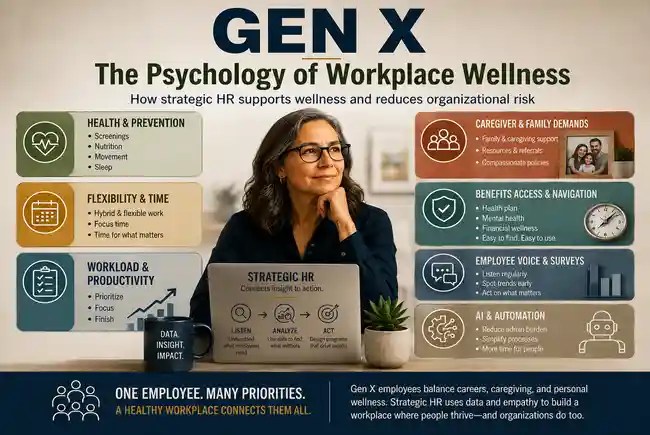
For the first time in modern workforce history, many HR teams are supporting four generations working side by side. They may work under the same policies, receive the same benefits guide, and report through the same organizational structure, but they are not necessarily experiencing work from the same place in life.
That matters when we talk about wellness.
The goal is not to build four different workplaces or assume everyone born within a certain set of years thinks alike. It is to recognize that life stage can change what makes a benefit valuable, what creates stress, and what an employee needs in order to remain healthy and productive.
For Gen X, now roughly 46 to 61 years old, wellness appears to be both holistic and highly practical. Health matters, but so do family, career, financial security, flexibility, mental wellbeing, and time. Increasingly, those things cannot be neatly separated from one another.
That creates an important question for strategic HR:
Are we still thinking about wellness as something we offer employees, or are we thinking about whether the entire experience of working here allows people to remain well?
Gen X gives us a particularly useful place to begin.
1. Health Gets Real: Wellness Becomes Prevention
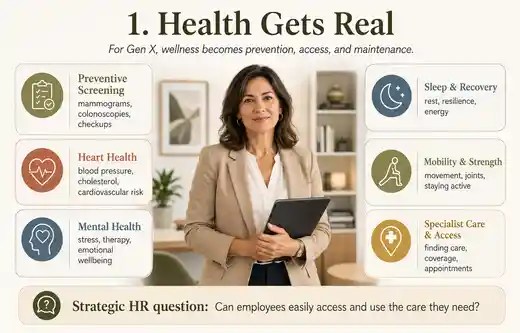
There is a point somewhere in midlife when health quietly starts getting more of our attention. You are not old. You probably do not feel old. You may still be raising children, leading teams, changing careers, learning new technology, and planning what you want the next twenty years to look like. But you are also no longer 25, and staying well begins to require a little more intention.
That shift shows up in the research. The Mather Institute’s Gen Xperience Study identifies family, career, and health among Gen X’s important life priorities. For a generation now solidly in midlife, wellness increasingly includes very practical things: preventive care, sleep, movement, mental health, managing existing conditions, and addressing problems before they become larger ones.
The medical calendar reinforces that shift. The U.S. Preventive Services Task Force, for example, recommends colorectal cancer screening beginning at age 45 for average-risk adults. Blood pressure, cholesterol, mammograms, medication management, and specialist visits also begin occupying more space in everyday life.
For Gen X women, this stage can bring another layer. The American Heart Association describes perimenopause as a potential “window of opportunity” for cardiovascular prevention as changes in cholesterol, blood sugar, and other measures of heart health can emerge during this period.
None of this means Gen X should suddenly be viewed as an unhealthy workforce. It means many employees in this cohort are becoming increasingly aware that staying healthy requires participation.
For HR, that matters because employers provide much of the infrastructure employees use to act on that awareness. The medical plan, provider network, mental-health coverage, prescription benefits, preventive-care resources, PTO, scheduling practices, and even the attitude of a direct manager can influence whether employees are realistically able to use the care available to them.
That also changes how strategic HR should think about wellness. The movement is increasingly away from a collection of disconnected, stand-alone wellness vendors and toward a more integrated health and benefits ecosystem. Prevention, behavioral health, chronic-condition management, women’s health, telehealth, pharmacy, and care navigation are becoming part of a more coordinated benefits experience.
The HR question therefore becomes more useful than simply asking whether the organization has a wellness program. We should be asking whether employees can actually find, understand, access, and use what we are already paying for.
Short employee-response surveys can help us answer that without asking employees to disclose diagnoses or private medical information. We can ask whether benefits are easy to find, whether schedules interfere with accessing care, whether managers support reasonable time away, and which resources employees actually find useful.
AI can make that listening much easier to sustain. An appropriately designed agent can distribute brief pulse surveys, follow up, aggregate responses, and identify recurring themes without creating another large administrative project for HR. The HRBP remains responsible for the part that matters most: understanding what the patterns mean and deciding what the organization should do about them.
Gen X is not asking an employer to make employees healthy. The more strategic question is whether the employment experience gives people a reasonable opportunity to stay healthy.
2. Making Room for Wellness
Knowing that wellness matters and having enough room to practice it are not necessarily the same thing.
The Mather Institute’s Gen Xperience Study found that self-care matters to nearly all Gen X respondents, yet 41% said they are not getting as much of it as they need.
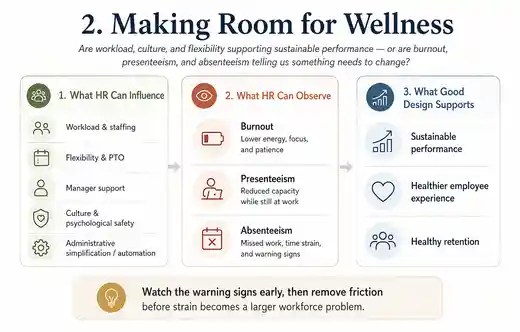
For HR, that is useful information, not a diagnosis. We do not need to decide why an individual employee is not sleeping enough, exercising, scheduling a physical, seeing a therapist, or taking needed time away. What we do need to understand is what may begin happening at work when employees repeatedly lack enough time or capacity to recover and take reasonable care of themselves.
One of the first effects may be surprisingly easy to miss: presenteeism.
The employee is at work. Attendance looks fine. But the person who normally brings good judgment, patience, concentration, and energy may be operating at something less than full capacity. Stress, inadequate recovery, poor sleep, health concerns, or responsibilities competing for attention can show up as slower work, difficulty concentrating, mistakes, irritability, or simply less energy available for the job.
NIOSH identifies burnout as being associated with lower productivity and performance, along with greater presenteeism and absenteeism.
That is significant for HR because presenteeism can hide inside perfectly respectable attendance numbers. The employee has not called off. They have not resigned. They may not even have complained. Yet the organization may already be receiving less of their normal contribution.
Over time, the strain may become easier to see through attendance. Medical appointments cannot always wait. Family responsibilities arise. Employees eventually need time for themselves or someone who depends on them.
Caregiving is not unique to Gen X, but it is highly relevant to this cohort. Mercer’s generational benefits research found that 74% of Gen X employees identified as caregivers.
If the conflict continues, it can eventually become a retention issue. SHRM’s research on working caregivers found that insufficient support can contribute to employees reducing hours or workloads, missing work, or looking for jobs that offer greater flexibility.
For strategic HR, that gives us a useful progression to watch: presenteeism, attendance strain, and eventually retention risk. None of those measures tells us exactly why an individual employee is struggling. Together with employee feedback about workload, flexibility, PTO, benefits access, or manager behavior, however, they can reveal a pattern worth investigating.
Mather’s research also gives us a very practical clue about what may help. Among Gen X employees who had access to flexible scheduling, 88% used it and 93% of those users said it had a positive effect on their wellness.
Flexibility does not mean lowering standards or converting every position into a remote job. It can mean an adjusted start time for an appointment, predictable scheduling, the ability to move an hour of work when circumstances require it, reasonable use of PTO, or simply greater control over how good work gets accomplished.
Sometimes the most useful wellness support is not another program. It is enough control over time to use the resources employees already have.
HR is uniquely positioned to find out whether that is happening. Claims data can tell us what healthcare costs, and benefits data can tell us what employees use, but neither tells us what it feels like to try to use those benefits while actually doing the job. Short, regular employee-response surveys can.
Useful questions might include:
- Are you able to use the PTO and flexibility available to you?
- Does your work schedule make it easier or harder to take care of your wellbeing?
- Do you feel comfortable taking time for necessary appointments?
- Does your manager support reasonable flexibility?
- What creates unnecessary pressure in your workday?
- Is there administrative work that could be simplified or automated?
- What one change would make it easier to manage work and personal responsibilities?
Again, AI gives HR an opportunity to make that feedback loop sustainable. An agent can handle routine survey distribution, reminders, aggregation, comment themes, and trend comparison while HR focuses on interpretation and action.
Automation can also affect wellness more directly. Gen X spent much of its career doing administrative work that technology can now complete in minutes. Removing duplicate entry, manual follow-up, repetitive reporting, unnecessary status work, and other low-value tasks gives an organization something valuable: capacity.
What happens to that capacity is a strategic choice. If every hour technology saves is immediately filled with another hour of work, we have improved efficiency. If some of that efficiency also produces a more sustainable workload, more control over time, or greater capacity for meaningful work, we have improved the employee experience as well.
For HR, the lesson is not to supervise employees’ self-care. It is to recognize the observable business signals when people do not have enough room for wellness and determine whether the organization is contributing unnecessary friction.
Watch presenteeism before it becomes absenteeism. Watch attendance strain before it becomes turnover. Then listen closely enough to understand what you can change.
3. The Psychology of Access: When Wellness Becomes Part of the Employee Experience
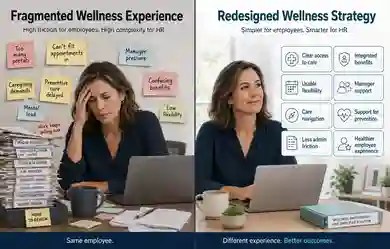
Employees do not experience wellness as a collection of benefits. They experience it as the cumulative effect of how easy—or difficult—the organization makes it to stay well.
That distinction matters as employers move away from the older model of multiple stand-alone wellness vendors and toward a more integrated health and benefits strategy. Business Group on Health has described employers increasingly streamlining vendors and looking for better coordination among medical plans, mental-health resources, navigation, chronic-condition support, prevention, and other wellbeing services. The goal is not simply fewer vendors. It is a simpler, more connected experience for employees.
From a psychological standpoint, that matters because complexity creates friction.
An employee may technically have access to mental-health support, preventive care, a navigation service, chronic-condition resources, an EAP, and telehealth. But if each one requires a different portal, another password, a separate phone number, and a different explanation of what is covered, the employee may experience the benefits package as one more thing to manage.
That is not particularly supportive of wellness.
A more integrated approach can reduce some of that cognitive load. Employees are more likely to use a benefit when they understand where to start, what the benefit does, how to access it, and whether they can realistically make room for it in the workday.
For Gen X, that practicality fits what the research has been telling us throughout this discussion. Wellness is not necessarily about wanting more programs. It is about whether the resources already available can be used in ways that fit real life.
The psychology of workplace wellness therefore includes several things HR can influence: whether employees feel they have enough control over their time to take care of themselves; whether they understand the benefits available to them; whether they trust that using PTO or flexibility will not quietly damage their standing with a manager; whether obtaining help feels straightforward or overwhelming; and whether the organization’s day-to-day behavior supports the message it communicates during benefits enrollment.
That last point may be the most important.
An organization can provide an excellent medical plan and still create a workplace that works against it.
The CDC/NIOSH Total Worker Health framework treats the conditions of work as part of employee health rather than something separate from it. Excessive workload, low employee control, poor supervisory practices, unresolved conflict, chronic understaffing, and other harmful working conditions can contribute to stress and undermine the very wellbeing employers are investing in through their benefits programs.
Employees do not experience the medical plan, their manager, the PTO policy, the workload, and the organizational culture as five different companies.
They experience one organization.
For strategic HR, that changes the questions we ask. Rather than simply measuring enrollment or benefit utilization, we need to understand how the entire system is functioning from the employee’s point of view.
Long-term wellness strategy should consider:
- Simplifying the employee experience. Reduce unnecessary vendor fragmentation where possible and give employees a clear path into medical, mental-health, preventive, and navigation resources.
- Measuring access, not just availability. A benefit that exists but is difficult to find, understand, afford, or schedule has limited practical value.
- Connecting workforce data. Presenteeism, absenteeism, turnover, engagement, manager scores, PTO usage, and employee-relations concerns can reveal more when HR looks for patterns across them rather than treating each metric separately.
- Including workplace conditions in wellness strategy. Workload, staffing, manager behavior, psychological safety, flexibility, and employee control can either reinforce or undermine investments in health and wellbeing.
- Listening continuously. Short pulse surveys, benefits follow-ups, stay interviews, and targeted employee feedback can show HR where friction remains and whether changes are actually helping.
- Using AI to reduce administrative burden. AI-supported tools can help distribute surveys, summarize themes, identify trends, and automate low-value administrative work so HR can spend more time interpreting what employees are telling us and acting on it.
- Evaluating value beyond participation. A successful wellness strategy should ultimately support outcomes that matter to the organization: healthier employees, stronger engagement, better attendance, improved retention, and a more credible employee value proposition.
That is where wellness becomes a workforce strategy rather than a benefits project.
Closing: From Wellness Benefit to Workforce Strategy
Gen X gives us a useful lens into workplace wellness because health, time, flexibility, financial security, and the quality of the work experience are increasingly difficult to separate at this stage of life. The research does not tell us that every Gen X employee wants the same thing. It gives us something more useful for strategic HR: signals worth paying attention to.
Those signals can appear in benefits utilization, employee feedback, presenteeism, absenteeism, workload concerns, manager effectiveness, engagement, and retention. Looking at them together can tell us much more than treating each one as an isolated HR metric.
The opportunity is not simply to add more wellness programs. It is to build a benefits and workplace strategy in which preventive care, mental health, flexibility, management practices, employee listening, and work design reinforce one another. Technology can help us listen more consistently, reduce administrative burden, and identify patterns sooner, but HR still owns the judgment about what those patterns mean and what should change.
In a four-generation workforce, the pressure points will change as employees move through different stages of life. The discipline for HR remains remarkably consistent: listen, understand, design, measure, and adjust.
Gen X may be making the wellness conversation particularly visible right now. What we learn from it can help us build a healthier and more sustainable workplace for everyone.
Closing Thought
The wellness value of a benefits package begins at the executive design table: what employees can access, how easily they can access it, and whether the way we design work allows them to use it.
From there, wellness becomes part of everyday employee experience. Incentives can encourage preventive care and healthy habits. AI and agentic tools can remind employees about benefits they already have, encourage preventive care and self-care, and make it easier to act before small issues become bigger ones. Going to the doctor, scheduling a dental visit, exercising, using PTO, or taking a child to an appointment are not activities separate from workplace wellness. They are part of the organic wellness ecosystem we create when we design benefits, policies, and work around the realities of employees’ lives.
For HR, the opportunity is to close the gap between offering a benefit and helping an employee actually benefit from it. When benefits are easy to navigate, managers support their use, and technology reduces administrative friction, employees have more opportunity to address health and life needs before those pressures begin appearing as presenteeism, absenteeism, disengagement, or unwanted turnover.
Workplace wellness isn’t a program employees visit. It is an ecosystem employers design—and thoughtful design makes staying well easier to practice as part of everyday life.
Further Reading for HR Leaders
For HRBPs, HR Managers, and benefits leaders interested in exploring where workplace wellness strategy is heading, these resources offer a deeper look at integrated benefits design, vendor strategy, and presenteeism.
Business Group on Health — Integrated Benefits Experience: Four Key Considerations A practical employer-focused look at moving from fragmented benefits and stand-alone solutions toward a more coordinated employee experience. It examines integration, navigation, communication, and how employers can make existing benefits easier for employees to understand and use.
Mercer — Choosing the Right Benefits Partner in a Complex Vendor Ecosystem A useful resource for HR leaders evaluating overlapping point solutions and vendor relationships. Mercer explores duplication, inconsistent employee experiences, unclear accountability, and the advantages of thinking about benefits as an interconnected ecosystem rather than a collection of individual programs.
McKinsey & Company — U.S. Workplace Benefits: Connecting Health, Wealth, and Wellness A broader strategic view of benefits integration. McKinsey examines how employers can create a more cohesive experience across health, financial wellbeing, retirement, mental health, caregiving, and other benefits rather than expecting employees to navigate each resource separately.
Worksite Health Promotion Programs and Presenteeism — PubMed For HR leaders who want to explore presenteeism more deeply, this research review examines how presenteeism is defined and measured and what the research suggests about workplace-health interventions that may influence it.
Sources Cited
Mather Institute — Gen Xperience Study Year 1 Year 2: Health & Wellness Year 3: The Multigenerational Workplace
Mercer — Generational Benefits and Wellbeing Smart Personalization: Providing Employee Benefits for Every Generation
SHRM — Working Caregivers Care and Careers: Navigating Caregiving and Work Responsibilities
SHRM — Employee Benefits Employee Benefits Research
Business Group on Health Integrated Benefits Experience: Four Key Considerations Trends to Watch in 2026
CDC/NIOSH — Total Worker Health About Total Worker Health Making the Business Case for Total Worker Health Hierarchy of Controls Applied to Total Worker Health
CDC/NIOSH — Workplace Stress and Burnout Stress at Work Burnout Prevention: Organizational Impact
U.S. Preventive Services Task Force Colorectal Cancer Screening
American Heart Association Perimenopause May Offer a Window of Opportunity for Heart Disease Prevention
Gallup — Wellbeing, Recruiting, and Retention The Importance of Employee Wellbeing Top Reasons Employees Take a New Job
Presenteeism Research Worksite Health Promotion Programs and Presenteeism
Mental Health and Workplace Productivity Mental Health and Workplace Productivity: A Critical Review


Leave a Reply