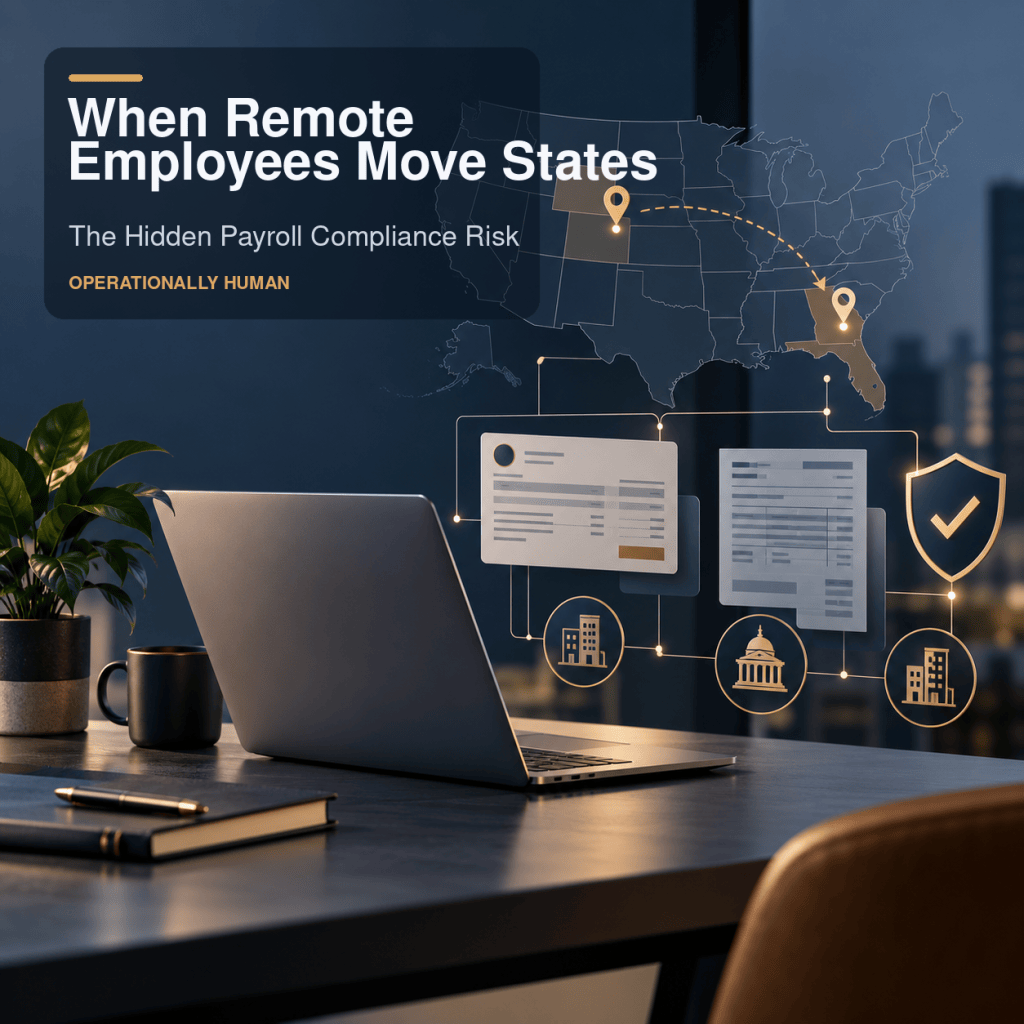
It sounds simple when an employee says it.
“I’m moving, but my job isn’t changing.”
Same title. Same manager. Same duties. Same laptop. Same payroll schedule. Same employer.
But if the employee is moving into or out of a state with significantly different wage, tax, leave, or deduction rules, the move may affect more than the work address. It may change the employee’s net pay, required deductions, overtime eligibility, paid leave contributions, reimbursement rights, or overall compensation treatment.
In an HCM and payroll environment, that move may be much more than an address change. When an employee physically begins working from another state, the employer may be entering a new tax and employment compliance jurisdiction.
That can affect state withholding, workers’ compensation, paid leave, disability insurance, local taxes, wage and hour rules, exempt status, agency registrations, and possibly broader business or tax nexus.
The business may still think of itself as operating in one state. The payroll register may tell a different story.
Payroll Tune-Up
- Treat a remote employee relocation as a compliance event, not an address update.
- Confirm whether the new work state is already supported by the employer’s payroll and compliance infrastructure.
- Start the review before the employee begins working from the new location.
What Payroll Needs From HR Before an Employee Moves States
Payroll cannot correctly process a state move if HR only sends an address change after the employee has already relocated.
In a modern HCM environment, the employee’s work location should not be treated as a static demographic field. It is a compliance driver. The work location field may feed tax jurisdiction mapping, workers’ compensation coding, paid leave deductions, wage and hour configuration, and payroll register reporting.
If the HRIS record is incomplete or the HRIS-to-payroll integration does not transmit the correct location data, the payroll processor may continue calculating wages and taxes under the wrong jurisdiction.
Before the move takes effect, HR should provide payroll with the employee’s new physical work address, effective date, resident state, work state, whether the move is permanent or temporary, whether the employee will work in more than one state, and whether the employee will still report to an office in the original state.
Payroll also needs the approved compliance outcome: which tax jurisdictions apply, which deductions or employer contributions must be active, whether workers’ compensation coding changes, and whether wage and hour rules require payroll configuration changes.
The issue is not just whether the employee record was updated. The issue is whether the downstream payroll setup reflects the approved compliance decision before wages are processed.
Payroll Tune-Up
- Capture the new physical work location, effective date, resident state, and work state before the move occurs.
- Confirm the HRIS-to-payroll feed sends the correct location data to payroll.
- Validate that the payroll setup reflects the approved work-location change before payroll runs.
Do You Need to Register in a New State When an Employee Moves There?
A single remote employee moving into a new state requires the employer to evaluate whether it must register with one or more state agencies, especially if the employer does not already have those accounts, registrations, or compliance relationships in place.
That review may include Secretary of State foreign qualification, Department of Revenue withholding registration, state unemployment insurance registration, paid family and medical leave registration, state disability insurance registration, workers’ compensation coverage, local tax registration, state labor department requirements, required employment notices, and corporate income or franchise tax nexus.
Payroll does not own those decisions. They belong across HR, legal, finance, tax, benefits, insurance, and corporate compliance.
But payroll must be advised of the approved outcome because those decisions may require payroll system changes before the next payroll is processed.
Payroll Tune-Up
- Identify whether the employer already has the required state accounts and registrations.
- Route unsupported states to legal, tax, insurance, benefits, and compliance before approval.
- Communicate the approved state setup to payroll before wages are processed.
Payroll Does Not Own the Rule, But Payroll Must Prove the Rule Was Applied
Payroll is not usually the department deciding whether state disability insurance applies, whether workers’ compensation coverage must be updated, whether employment notices are required, or whether the company must register with a new agency.
But payroll is responsible for making sure the approved decisions are reflected in the payroll system and visible in payroll output.
That means the correct fields, codes, deductions, tax jurisdictions, wage bases, employer contributions, and reporting settings must appear in the payroll processor. Whether the platform is ADP, UKG, Rippling, Paychex, Gusto, or another HCM/payroll system, the compliance decision has to translate into configuration.
HR can create the policy. Legal can approve the requirement. Finance can open the account. Insurance can update the coverage. But if the HRIS rule does not flow correctly into payroll, or if the payroll configuration does not produce the correct pay statement, register, tax file, or agency report, the compliance process is incomplete.
From the employee’s perspective, the paycheck is the proof. From the employer’s perspective, the payroll register and agency reporting are the audit trail.
Payroll Tune-Up
- Match approved compliance decisions to payroll codes, deductions, taxes, and wage bases.
- Review the pay statement, payroll register, and agency reporting for proof that the setup worked.
- Keep an audit trail showing when the change was approved, configured, validated, and paid.
Hot Zone Moves Need a Deeper Review
Some states are not simple “add a withholding account” states. They are payroll hot zones.
If an employee moves into California, New York, New Jersey, Massachusetts, Washington, Oregon, Colorado, Connecticut, Illinois, or a similar jurisdiction, the employer may need a deeper review before approving the move.
The issue is not only income tax. The move may affect overtime rules, exempt salary thresholds, paid leave deductions, disability insurance, local taxes, workers’ compensation, expense reimbursement, final pay rules, pay frequency, wage notices, and state registration requirements.
In these jurisdictions, payroll configuration may need to change at multiple levels: tax jurisdiction mapping, statutory deduction setup, leave accrual logic, overtime rules, wage statement requirements, and payroll register output.
The question should not be, “Can we update the address?”
The question should be, “What changes because this employee is now physically working there?”
Payroll Tune-Up
- Maintain a hot-zone checklist for states with complex wage, leave, tax, and payroll rules.
- Flag high-risk jurisdictions before the relocation is approved.
- Confirm the payroll system can support the state’s required deductions, wage rules, pay statement requirements, and reporting.
Hot Zone Moves Should Trigger an Exempt Status Review
A move into a high-compliance state should also trigger a review of the employee’s exempt or non-exempt classification.
This is a common employer mistake: assuming that because an employee is paid a salary, the employee is automatically exempt from overtime. That is not how the rule works.
Under the Fair Labor Standards Act, most white-collar exemptions require more than salary. The employee generally must satisfy a salary basis test, a salary level test, and a duties test. A title alone is not enough. A salary alone is not enough. The employee’s actual job duties matter.
That becomes especially important when an employee moves into a state with stronger wage and hour rules, higher salary thresholds, daily overtime requirements, or more aggressive enforcement.
If the exemption does not hold under the new state’s rules, payroll may need to convert the employee to non-exempt, activate time tracking, apply the correct overtime calculation, and update wage notices or pay documents before the next payroll cycle.
In a hot zone state, the question is not simply, “Is this employee salaried?”
The better question is, “Can we defend this exemption under the rules of the state where the employee is now performing the work?”
Payroll Tune-Up
- Review exempt status when an employee moves into a stricter wage and hour state.
- Confirm salary threshold, duties test, timekeeping needs, and overtime configuration.
- Document the classification decision before payroll processes wages under the new state.
Build a Remote Work Relocation Policy Before the Move Happens
A remote work relocation policy should exist before the first employee asks to move.
The policy does not need to punish employees for relocating. It needs to make clear that a work location change is a compliance event, not just a personal address update.
A strong policy should require employees to request approval before changing their primary work location. That request should trigger an HRIS workflow that captures the new physical work location, effective date, resident state, work state, expected schedule, and whether the move is temporary or permanent.
The workflow should then route the request through the appropriate approval matrix: HR, payroll, legal, finance, tax, benefits, insurance, and corporate compliance. The goal is not to slow down remote work. The goal is to make sure the company knows what obligations attach to the new location before payroll is processed.
For many employers, the policy should also define which states are currently supported and which states require additional review. Some employers may choose to support only states where they are already registered. Others may approve new jurisdictions case by case. Either approach is workable if the process is intentional.
Remote work has changed how easily employees can move without changing jobs. But it has not eliminated the employer’s obligation to understand where work is being performed, what that location requires, and whether the payroll system is configured to support it.
“I’m moving, but my job isn’t changing” may be true from the employee’s point of view.
For the employer, it may be the beginning of a new state compliance obligation.
Payroll Tune-Up
- Require advance approval before a remote employee changes their primary work location.
- Build an approval matrix showing who owns registration, tax, insurance, benefits, HRIS, and payroll validation.
- Require payroll validation before the first paycheck is processed under the new work location.

